When Washington Moves, Your Supply Chain Should Already Be Moving: A Playbook for Policy-Proof Importing
Ask any importer who has been in the game for more than a decade what changed, and you'll rarely hear them talk about freight rates or factory capacity first. You'll hear about the whiplash.
A Section 301 announcement on a Tuesday. A exemption granted on a Friday, revoked the following spring. Exclusion processes that open and close like drawbridges. For American buyers, the problem is no longer predicting what Beijing or Brussels will do — it's accepting that nobody, including the people writing the rules in Washington, can reliably predict what Washington will do next.
The importers thriving under this volatility share one trait: they stopped treating trade policy as a forecast and started treating it as weather. You don't plan your business around a sunny day. You build a roof.
The End of the Stable-Planning Era
For most of the post-war era, tariff schedules moved glacially. A mid-sized importer could lock in a sourcing strategy, run the numbers, and trust that the landed cost on their spreadsheet would still be roughly accurate two years later. That era is over.
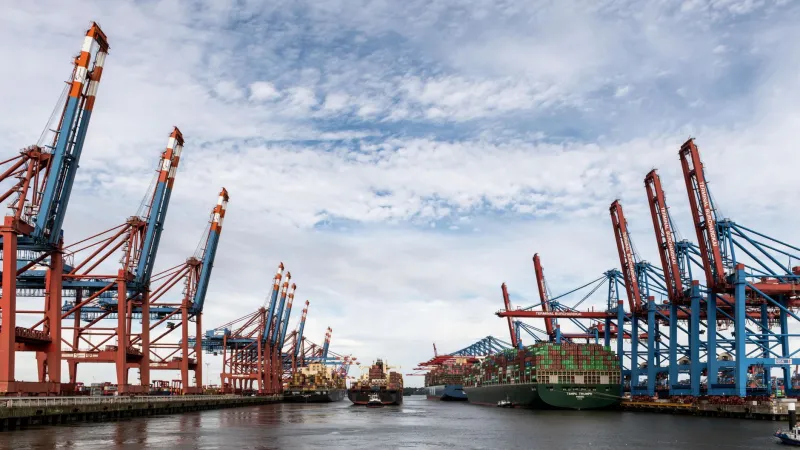
In the current environment, a single Federal Register notice can reprice an entire product category overnight. Companies that had signed annual purchase orders based on old duty rates suddenly found their margins evaporating before containers cleared the Port of Long Beach. The lesson wasn't that they planned poorly — it's that planning around stability is now itself the planning error.
Hedging Strategy One: The Dual-Source Discipline
The most common response we see among experienced US buyers is dual sourcing — not as a cost optimization, but as an insurance policy. If one origin country gets swept into a new tariff action, production can shift to a second supplier in a different trade lane within weeks, not quarters.
The practical version looks like this: a home goods distributor we work with splits production of a single SKU between a factory in Vietnam and one in Mexico. Neither is the cheapest option available. Together, they mean that no single trade policy decision can strand the company without product. The buyer pays what amounts to a small premium for optionality — and considers it cheap compared to the alternative.
The key insight is that dual sourcing only works if both suppliers get real, recurring volume. A backup factory you never order from won't prioritize you when you suddenly need 40,000 units by month's end.
Hedging Strategy Two: Bonded Warehouses and Foreign Trade Zones
Tariffs are only due when goods enter US commerce — and that timing is more flexible than many importers realize. Goods held in a bonded warehouse or a Foreign Trade Zone (FTZ) have not yet cleared customs. If a tariff drops while your inventory sits in the zone, you pay the lower rate. If it rises, you've bought yourself time to make an informed decision rather than a panicked one.
During the last major round of tariff escalation, importers with goods positioned in FTZs near major ports had choices their competitors didn't: hold, re-export, or enter goods strategically as exclusions opened and closed. Importers without that flexibility had exactly one option — pay and hope.
The setup cost is real, and for low-volume importers it may not pencil out. But for anyone moving meaningful container volume, it converts a policy shock from an emergency into a scheduling decision.
Hedging Strategy Three: Tariff Engineering, Done Legitimately
Tariff engineering has an unsavory reputation, but at its core it's simply product design with customs law in mind. The classic historical example: the Converse sneaker case, where a felt-sole design change legally shifted the product into a lower duty classification. Courts have repeatedly affirmed that importers may structure their products — and even where final assembly occurs — to achieve the correct, lawful classification.
In practice, this can mean adjusting a bill of materials so a product qualifies as originating in a preferential-trade partner country, or redesigning packaging so goods fit a different Harmonized System heading. The line between smart engineering and evasion is bright and well-lit, and every legitimate strategy should be reviewed by a licensed customs broker or trade counsel. But ignoring the opportunity entirely is simply leaving margin on the table.
The Trading Partner as Buffer
There's a reason this approach is central to how we work with US clients. A trading partner — a firm whose entire business is the cross-border transaction — absorbs volatility for a living. When rates change mid-shipment, a good partner knows which bonded facilities have space, which alternate origins can produce your spec, and which exclusions your product might qualify for. When you source directly from a single factory, that factory's job is to make product. It is not structurally incentivized to protect you from Washington.
The relationship matters most in the first 72 hours after a policy change, when the buyers who panic-lock in bad freight contracts and overpay for spot capacity are the ones who didn't have someone on their side of the transaction working the problem.
Build for the Storm You Can't Forecast
None of these strategies require clairvoyance. That's the point. Dual sourcing, bonded warehousing, and tariff engineering don't depend on knowing what the next trade action will be — they depend on accepting that one is always coming.
The American importers who will be here in ten years aren't the ones with the sharpest predictions. They're the ones whose supply chains bend without breaking, and who treat every policy announcement not as a crisis, but as a test their structure was built to pass.